Showing posts with label audi. Show all posts
Showing posts with label audi. Show all posts
Tuesday, June 4, 2013
New Car Review 2013 Audi A4 2 0T quattro tiptronic
 |
| The 2013 Audi A4 2.0T quattro. |
As weve noted here at TireKicker before, the worst part of a successful car is keeping the ball rolling...doing the freshening needed to keep the car relevant without losing the thread and screwing it all up. Last time around, two and a half years ago, I worried that Audi was letting the magic of the A4 slip away. If they were, they fixed it in a hurry.
The 2013 Audi A4 2.0T quattro is simply tremendous. A car that pulls of the trick of feeling utterly contemporary and timeless at the same time. The timeless thing is important because Audis had the A4 pretty close to perfect for a long time. To wander too far from what has made an A4 an A4 for the past decade or so would be courting disaster.
The 2.0T quattro tiptronic is a 2.0 liter turbocharged inline four, making 211 horsepower....mated to Audis quattro (the lower case "q" is intentional) full-time all-wheel-drive system and the tiptronic (the lower case "t" is also intentional) 8-speed transmission with sport and manual shift modes. Base price: $34,600, and thats a rock-solid price for the car...neither too high nor too low.
Standard equipment includes anti-lock brakes with brake assist, 17-inch 10-spoke wheels on all-season tires, electronic stability control, electromechanical speed-sensitive power steering, a dynamic five-link front suspension, a dynamic trapezoidal-link fully independent rear axle, power glass sunroof, halogen headlights, front and rear foglights, rain and light sensors, heated and powered outside mirrors, leather seating surfaces, a 12-way power drivers seat and an 8-way power passengers seat, automatic climate control, Audi concert radio with premium sound, including AM/FM/SiriusXM/CD, with SD Card, USB and auxilary inputs, and the usual airbags and alarms.
Going small in displacement with the 2-liter engine and an 8-speed transmission delivers strong fuel economy numbers, too...20 city/30 highway.
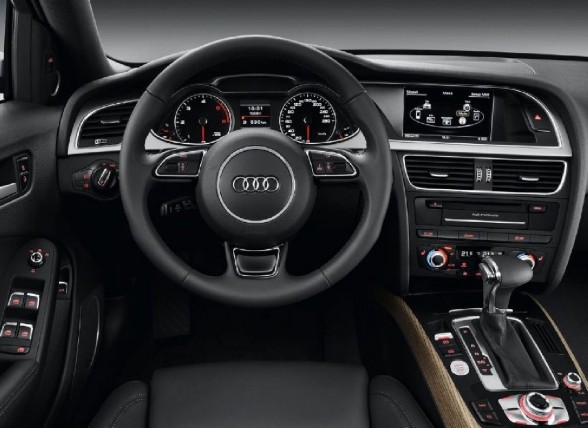 |
| 2013 Audi A4 interior. |
The interior continues to be a best-in-class effort (despite my concerns in 2010)...and our options tended to enhance the time spent at the wheel: The $4,200 Premium Plus package delivered auto-dimming mirrors inside and out, an iPod cable, Bluetooth, a driver information system with trip computer, heated front seats with driver memory, a split-folding rear seatback, HomeLink garage door opener, a three-zone climate control plus Xenon plus headlamps, LED daytime running lights and taillamps, and an upgrade to 18-inch 10-spoke wheels. The car was also treated to polished exhaust tips for $140 and an extra-cost paint job (Monsoon Gray metallic) for $475. With $895 destination charges, the bottom line wound up at $40,310.
Theres no question the Audi A4 lives in a competitive world (the BMW 328i, also packing a 2-liter turbo four is probably its deadliest nemesis), but its hard to imagine a car holding its ground better. If you cross-shop the A4 and the 3-series, itll be personal preference, not a weakness in either vehicle, that will most likely be the deciding factor.


Thursday, May 23, 2013
How to Clean an Audi Mass Airflow Sensor
1. Pop the hood and locate the mass air flow sensor. Its located between the throttle body and the air filter on the intake tubing and has a wiring harness plugged into it. Unplug this harness, using your hands.
2. Use the flathead screwdriver to loosen the hose clamps securing the mass air flow sensor to the intake tubing. Then pull out the sensor with your hands and place it to the side.
3. Spray the mass air flow sensor cleaner liberally inside of the sensor, making sure to spray the wiring in the middle of the sensor as well. Allow it to air-dry for at least an hour before reinstalling.
4. Reinstall the mass air flow sensor, using the flathead screwdriver to secure the hose clamps to either side of the sensor, then plug the harness back in place.
Sunday, May 12, 2013
How to Install Wider Tires on an Audi
1. Decide what size tire you want to install. You may or may not be able to use your existing wheels, depending on what the width of the new tire is going to be. If you want to install tires that are a lot wider than your existing ones, you may have to use wider wheels as well. An example would be replacing 205/60-16 tires with 255/45-16 tires. The new wider tire would probably not fit comfortably on the wheels. If you are installing tires that are only a little wider, you can use your existing wheels. An example would be replacing 205/60-16 tires with a 225/55-16 tires. Using new wheels will also allow you to go with a larger-diameter wheel and tire package.
2. Determine how wide your wheels are. Audis come with a wide range of wheel sizes, some wide and some not so wide. Look in your owner’s manual or the back of the wheel for the sizes. To look at the back of the wheel, loosen the lug nuts, raise the car and remove the wheel. Give the sizes to a tire professional to determine what tires will fit.
3. Ensure that the outer diameter of your new tire is the same as your old tire. This will be determined by the profile of the new tire, which is the distance from the outer edge of the wheel to the outer part of the tire. If the wheel and tire are shorter or taller, your speedometer will not read correctly.
4. Purchase your new tires and, if applicable, new wheels.
5. Have the tires installed on your existing wheels if you did not get a wheel and tire package. Do not attempt to install the tires yourself because it requires special equipment to perform properly. If you purchased a wheel and tire package, you can install them yourself. Loosen the lug nuts for the wheels, and lift the vehicle with a floor jack. Install the new wheels and tires one corner at a time.
Friday, May 10, 2013
Audi a3 Manual

The Principle The Audi A3s shine fastback-wagon profile, hostile styling cues, and big devalue wheels are the fitness of a pretty mod object. Figure in the 42-mpg highway rating that come with the A3 TDI, and you jazz a really pleading package The Audi A3 dynamical experience is a joy in most respects: nonfat, shortest, and civilized. Audis magnetised journey system is available on the A3 and improves the full see; sound maneuverability and a compounding of frizzy response at low movement and worthy unchangingness on the highway pee interiors that Audi currently makes: ergonomically easy, flawless, and recovered crafted. Whatever might say that its starting to face a bit dated, but versus any of the capitalistic set at the low end of its damage range-well under $30k-the A3s region looks far many upscale and nuanced in arrangement. Its a bit minuscule, but its well laid-out and exquisitely crafted. The proximity standard leather buckets sit low, and demand the back substantiation needed in specified a car and can venture backaches on long journeys, tho they give a prospect out. For a car of this situation, rear-seat accommodations are right unexceptionable, allowing you to twitch a set of adults in there-provided the passengers in lie don noesis scooting impertinent an progress or two. Levels of cultivation and inward fit and terminate are improve than most else bantam cars. Nevertheless traveling noise-and the sound of the kinda low-profile tires-can be irruptive on gritty surfaces, and copulate character with the criterial abatement can be somewhat formal. The 2011 Audi A3 has an equipment set that wed unexceeded draw as existence what "content luxuriousness" is all almost. Piece it appeals to those who strength seem at a well-equipped Subaru WRX or Mazda3, it has a stronger characteristic set than those vehicles at roughly the unvarying terms. Fog lamps, reflexive condition hold, keyless content, leather upholstery, and a 140-watt, ten-speaker strong group are all value. Payment Positive models are a manoeuvre up and include argonon headlamps, large alloy wheels, a superpower wood lay, steering-wheel audio controls, ambient LED illumination, and LED flowing lamps.
Thursday, May 9, 2013
User Manual audi A3

In its end mould year before a consummate redesign, the 2013 Audi A3 betrays its age mostly in its want of disturbance restraint and outdated infotainment offerings. But it remains a snazzy, voluptuous case hatchback that handles asymptomatic, conveys the standing of the four-ringed badge, and offers one deciding service of its competitors do: a fuel-efficient turbodiesel engine. This is the afoot A3s eighth year on the mart, but its program is all but unchanged. Whatever of the softer curves may appear dated from reliable angles, but the upcoming match doesnt aspect much distinguishable in proportion--its lines are crisper--so the A3 carries its period vessel both inner and out. The nonobligatory big impurity wheels especially allot it a sporty case that suits the Audi call. The accepted A3 engine is a 200-horsepower, 2.0-liter turbocharged quartet, which feels anxious and doesnt need to be revved sky-high to verbalise its goodly cognition. Our own competition, especially for highway locomote, is the 2.0-liter TDI turbodiesel quatern, which puts out 140 hp but oodles of force. A six-speed exercise is offered with the hydrocarbon engine, but most A3s module turn with Audis excellent S-tronic six-speed dual-clutch casing. If you essential the quattro all-wheel track group, its only free with the petrol engine and the S-tronic automatic, though. here
Wednesday, May 8, 2013
How to Remove the Outer Handle on an Audi Q7
1. Raise the hood and loosen the nut on your negative battery cable using a wrench. Set the cable aside, making sure it doesnt touch the positive terminal.
2. Open the door you wish to remove the outer handle from. Pry up the trim cover from around the inside door handle with a flathead screwdriver.
3. Remove the cover on the screw in the inner door handle well.
4. Remove all the screws with a Phillips-head screwdriver that you can find on the inside door panel.
5. Pry loose the inside door panel using a flathead screwdriver. Reach behind the panel and unplug all electrical connections.
6. Unpeel the waterproof plastic behind the panel.
7. Loosen and remove the two bolts attached to the handle using a socket wrench..
8. Position yourself on the outside of the vehicle and pull the handle from the door. For the back doors, you are done. On the front doors, unclip the rod from the handle and then turn the handle to release it
Friday, May 3, 2013
How to Replace a Battery in an Audi Key
1. Flick the key out as if you were going to be opening the door. Locate the thin line that goes across the width of the key parallel with the buttons on the key and which is where the two halves of the key meet.
2. Wedge a thin screwdriver or similar tool carefully into this dividing line. Note that this is not the same thing as the holes or the grooves that are located inside the recess of the key fob.
3. Twist the screwdriver slightly to separate the key portion from the fob portion of the key fob assembly. Wedge the screwdriver into the top of the fob, the sides and the back and twist until the two sides separate. This may take some force, but be very careful not to break the plastic.
4. Open the small plastic ringed end of the lid that is located in the side of the key that does not have the button on it. The lid can be gently pried open with your nail or even the screwdriver, but be careful not to break the lid as you pull it out. Do not touch the computer chip under the lid.
5. Remove the old battery and install the correct new battery, available from the Audi dealer. Replace the lid and snap the two halves of the key back together.
Wednesday, May 1, 2013
How to Change the Audi V6 Timing Belt
1. Disconnect the negative battery cable with a socket wrench. Detach the accessory drive belt from its pulleys. Turn the crankshaft clockwise by hand to align the timing mark on the crankshaft pulley with the timing mark on the crankcase. The timing marks on the camshaft must also align with their respective timing marks on the crankcase.
2. Remove the plug from the left side of the engine block by the crankshaft with a socket wrench. Align the timing marks on the crankshaft again if necessary. Connect Tool No. 3242 to the crankshaft and tighten it slightly to hold it in place.
3. Disconnect the upper timing belt covers, crankshaft vibration damper and lower timing belt cover in that order. Loosen the mounting bolts for the camshaft sprockets with a socket wrench, and release the sprockets from the ends of the camshafts.
4. Turn the roller for the timing belt tensioner clockwise with an 8 mm Allen wrench to compress the tensioner. Place a 2 mm spring pin through the holes in the tensioner housing and plunger to hold the plunger in place. Turn the tensioner counterclockwise to release the tensioner.
5. Remove the mounting bolts for the crankshaft damper with a socket wrench and detach the damper from the crankshaft. Disconnect the serpentine belt from the idler pulley and remove the guard for the crankshaft damper. Detach the timing belt from its pulleys.
6. Align the timing marks for the camshaft and crankshaft pulleys, if necessary. Place the new timing belt onto the pulleys, so that the arrow on the timing belt points in the clockwise direction.
7. Turn the roller for the timing belt tensioner clockwise with an 8 mm Allen wrench to compress the tensioner. Pull the 2 mm spring pin from the housing of the tensioner plunger. Turn the tensioner roller counterclockwise to apply tension to the timing belt.
8. Connect the damper guard for the crankshaft and attach the serpentine belt to the idler pulley. Tighten the mounting bolts for the idler pulley bolts to 33 foot-pounds with a torque wrench. Replace the crankshaft damper and tighten its mounting bolts to 15 foot-pounds. Fasten the mounting bolts for the camshaft sprockets with a socket wrench. Install the timing belt covers.
9. Remove Tool No. 3242 from the crankshaft pulley. Install the sealing plug into its hole on the lower left side of the engine with a socket wrench. Attach the accessory drive belt and connect the cable for the negative battery terminal.
Tuesday, April 30, 2013
Audi R8 GT Spyder US Price

Audi announces pricing for the 2012 R8 GT Spyder limited edition. The all-wheel-drive, Lamborghini-V10-sporting convertible will sticker for $211,200 with destination. Only 333 examples will be built, with just 50 coming to the United States. Audi built the same number of hardtop GTs, with 90 coming stateside.
The new 2011 Audi R8 GT Spyder follows the identical recipe featuring a extra powerful V10 engine and a lighter body.The open-air model rides on a tweaked suspension with aluminium double wishbones, and comes with new set of 19-inch alloy wheels wrapped in 235/35 tires up front and 295/30 tires on the rear.
Power comes from a 5.2-liter V10 engine which produces 560 PS (412 kW / 552 hp) and 540 Nm (398 lb-ft) of torque. It enables the model - which weighs 187 lbs (85 kg) less than the standard R8 V10 Spyder - to accelerate from 0-60 mph in 3.8 seconds and hit a top speed of 197 mph (317 mph).
The black interior can be decked out with stitching in the buyer’s choice of Titanium Gray or Crimson Red. Alcantara is used for seat inserts, the flat-bottom sport steering wheel, hand brake cover and to frame the windshield.
The 2012 Manufacturer’s Suggested Retail Price for the limited-edition R8 GT Spyder is MSRP $210,000 (excludes $1,200 Destination and Delivery and Taxes).











Press Release
Audi Announces Pricing for the Limited-Edition 2012 Model Year R8 GT Spyder
The recently introduced Audi R8 GT Spyder is a hand-built, limited production vehicle with just 333 units produced world-wide and 50 units coming to the U.S. Similar to the R8 GT Coupe unveiled last year, each car will be uniquely distinguished with an individual vehicle number displayed on the gear shift.
The 2012 Manufacturers Suggested Retail Price for the limited-edition R8 GT Spyder is as follows:
MSRP $210,000 (excludes $1,200 Destination and Delivery and Taxes)
Even lighter, more powerful and captivating, the Audi R8 GT Spyder delivers breathtaking performance. The open-top flagship version of the high-performance sports Coupe features a 5.2-liter V10 with direct injection and has been boosted to an output of 560 horsepower. With the reduced weight and increased engine performance, the R8 GT Spyder accelerates from zero to 60 mph in 3.8 seconds and reaches a top speed of
197 mph.
Using the principles of Audi ultra lightweight technology, the R8 GT Spyder has trimmed a full 187.39 lbs from an already low weight, increasing fuel economy, performance, strength and rigidity. The engine frame is constructed of ultra-light magnesium, and the long cover over the soft-top compartment and the large side panels at the rear are made of carbon fiber-reinforced polymer. A fixed rear spoiler also made of carbon fiber composite provides the necessary downforce on the rear axle. The Audi R8 GT Spyder is capable of extreme lateral acceleration and engineered to deliver exceptional responsiveness through its sport suspension has a stiffer calibration and lowers the the R8 GT Spyder by ten millimeters versus the R8 V10 Spyder.Legendary quattro all-wheel drive system provides exceptional grip on 19 inch wheels and xyz ventilated and cross-drilled rotors provide exceptional stopping power.
Visual styling cues include a performance enhancing enlarged diffuser, front splitter and a fixed rear spoiler.
The interior is black and can be adorned with stitching in a choice of Titanium Gray or Crimson Red for added refinement. Alcantara applications include, seat inserts, flat-bottom sport steering wheel, hand brake cover and windshield frame.
R8 GT Spyder customer vehicle deliveries will begin as of February.
R8 GT Spyder Standard Features | Highlights:
- 5.2L 10-cylinder, gasoline engine, aluminum block
- quattro® all-wheel-drive
- Exterior mirrors: power adjustable, heated Front Airbags: Driver and passenger full-size dual-stage front airbags and knee airbags
- Side airbags: Driver and passenger seat mounted head and thorax airbags
- Front disc brakes: 8-Piston calipers, perforated, internally vented
- Rear disc brakes: 4-Piston calipers, perforated, internally vented
- LED headlights and daytime running lights
- Sport seats, heated, 10-way power with 4-way power lumbar
- Audi navigation system plus, 6-disc CD changer, Sirius Satellite Radio, Aux-in jack with 7 speakers and 5-channel amplifier with a total output of 140 Watts
- Preparation for mobile phone (Bluetooth®) with seatbelt microphone
R8 GT Specific Standard Features | Highlights:
- 19" R8 GT wheels with summer performance tires
- R tronic ®, 6-speed sequential gearbox with shift-by-wire technology and sports mode
- R8 GT specific sport suspension system
- R8 GT specific carbon fiber matte exterior mirrors
- R8 GT specific LED tail lights
- R8 GT specific aluminum door sill inserts
- R8 GT specific steering wheel
- R8 GT specific sport seats in Alcantara and leather
- R8 GT specific carbon fiber matte interior inlays (monoposto and interior door handles)
- R8 GT specific numbered aluminum gear knob
- Windshield frame in Alcantara
Optional Equipment | Highlights:
- Audi navigation system plus with Audi music interface w/ iPod® cable (replaces 6-disc CD changer)
- Audi Carbon Ceramic Brakes
- Bang & Olufsen Sound System (12 speakers 495 watt)
- Titanium Finish 19" 5-arm-double-spoke-design aluminum alloy wheels with summer performance tires
- Forged Aluminum 19" 5-twin-spoke-Y-design in matte silver look with summer performance tires
- Carbon fiber matte door and center console panels
- Windscreen Frame in Fine Nappa Leather (interior)
Subscribe to:
Posts (Atom)